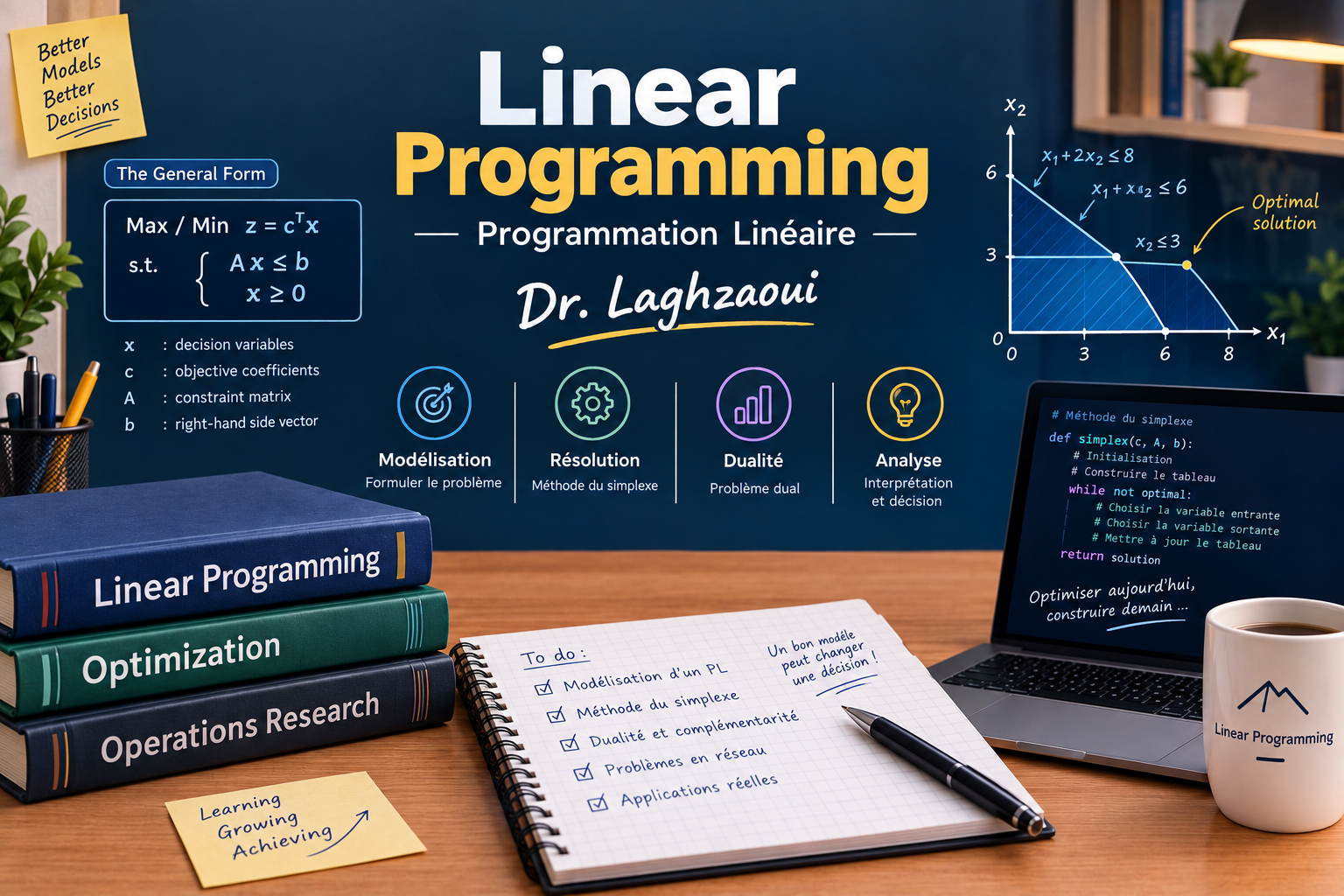
Linear Programming (LP) is a mathematical optimization technique used to model and solve decision-making problems involving the optimal allocation of limited resources. This module introduces students to the fundamental concepts of linear programming and enables them to formulate practical problems using decision variables, a linear objective function, and linear constraints. Students learn how to represent and analyze linear programs geometrically and algebraically, identify feasible and optimal solutions, and apply fundamental solution techniques such as the Simplex Method and the Dual Simplex Method. The module also introduces the concepts of duality, convexity, feasible regions, and extreme points, which provide the theoretical foundations for understanding linear optimization. Through practical examples, students develop the ability to formulate, solve, and interpret linear programming models applied to problems such as resource allocation, production planning, transportation, logistics, and scheduling.
- المعلم: Mohammed el amine LAGHZAOUI